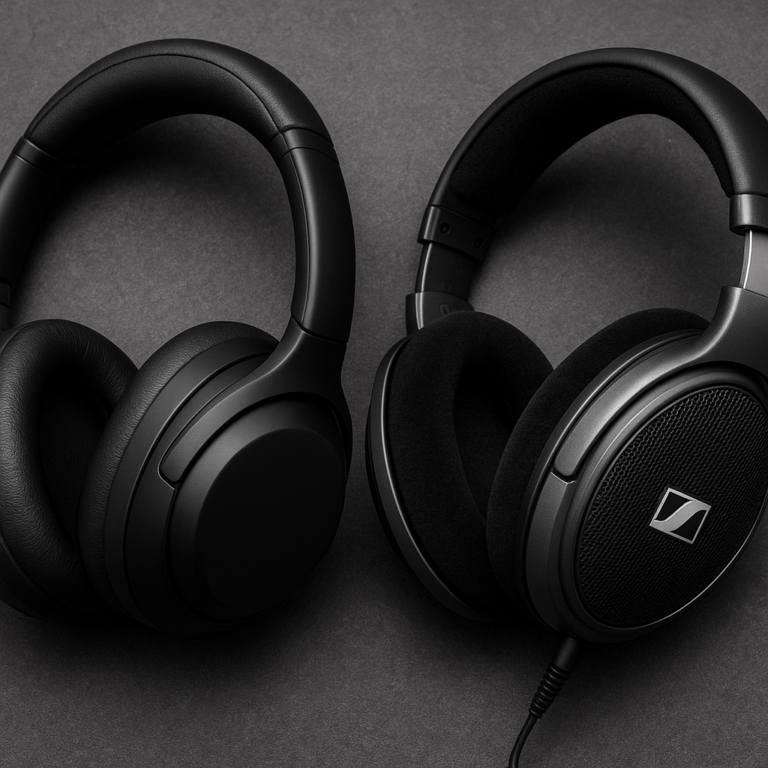
Support our educational content for free when you purchase through links on our site. Learn more
What Happened to Sennheiser? 🎧 (2026)


What happened with Sennheiser? The company did not disappear: Sonova acquired Sennheiser’s consumer audio business in 2021, while Sennheiser retained its professional audio division. That means Sennheiser headphones and earbuds still exist, but consumer products and professional microphones now follow separate corporate paths.
The split explains why one Sennheiser product may lead to a Sonova support page while another points to Sennheiser’s professional website. The logo stayed familiar; the corporate map got a little more tangled.
We have seen this confusion firsthand when comparing the HD 25, HD 600, and Momentum ranges. A product listing says “Sennheiser,” a warranty page says “Sonova,” and suddenly buying a pair of headphones feels like investigating a small audio conspiracy.
The good news? The famous HD 25, HD 600 family, professional microphones, wireless systems, and modern consumer headphones were not collectively abandoned. Some model names and regional listings changed, but Sennheiser remains active in professional audio and Sonova continues developing Sennheiser consumer products.
Key Takeaways
- Sennheiser did not go out of business. Its professional audio operation remains active.
- Sonova acquired Sennheiser’s consumer audio division in 2021, including consumer headphones and earbuds.
- The HD 25-1 II was not simply erased. The HD 25 family continues, although names, bundles, and regional listings vary.
- Sennheiser still makes professional headphones, microphones, wireless systems, and broadcast equipment.
- Modern consumer products include the Momentum 4 Wireless, Momentum True Wireless earbuds, and IE-series earphones.
- Check the product category and support website before buying: consumer products generally point to Sennheiser Consumer Audio, while professional equipment appears on Sennheiser’s official site.
- Our recommendation: choose Sennheiser by model and intended use, not just by the logo. The HD 25 remains a strong pick for DJs, the HD 600 series for wired audiophile listening, and Momentum models for wireless travel.
Table of Contents
- ⚡️ Quick Tips and Facts: What Happened with Sennheiser?
- The short answer: Sennheiser split its consumer and professional businesses
- Is Sennheiser still making headphones and microphones?
- What happened to the Sennheiser HD 25-1 II?
- Sennheiser’s History: From German Audio Pioneer to Global Brand
- The founding of Laboratorium Wennebostel in 1945
- How Sennheiser became famous for studio headphones
- The rise of the HD 414, HD 25, HD 600, and HD 800
- Sennheiser microphones, wireless systems, and broadcast audio
- Why Did Sennheiser Sell Its Consumer Electronics Division?
- Financial pressure and competition in the consumer headphone market
- The challenge from Sony, Bose, Apple, and other audio brands
- What Sennheiser announced in 2021
- How the Sonova acquisition changed the brand
- Sennheiser and Sonova: What the Ownership Change Means
- Which Sennheiser products belong to Sonova?
- What happened to Sennheiser Consumer Audio?
- What products remain with Sennheiser professional audio?
- Are Sennheiser products still German-made?
- Did the Sennheiser name, logo, or engineering change?
- What Happened to Sennheiser Headphones?
- Sennheiser audiophile headphones and open-back models
- Sennheiser wireless headphones and noise-cancelling models
- Sennheiser Momentum headphones after Sonova
- Sennheiser HD 600, HD 650, HD 660 S2, and HD 800 S
- Sennheiser IE in-ear monitors and audiophile earbuds
- What Happened to the Sennheiser HD 25-1 II?
- HD 25 versus HD 25-1 II: model names explained
- Why the HD 25 remains popular with DJs and broadcasters
- Replacement parts, cable options, and repairability
- HD 25 sound quality, comfort, isolation, and durability
- Should you still buy the Sennheiser HD 25?
- What Happened to Sennheiser Microphones and Professional Audio?
- Sennheiser’s professional business after the consumer sale
- Evolution Wireless, Digital 600, and wireless microphone systems
- MKH studio microphones and broadcast recording gear
- Neumann’s relationship with Sennheiser
- Sennheiser products for musicians, filmmakers, and live sound
- Sennheiser Product Availability, Discontinued Models, and Support
- Why some Sennheiser models disappeared from retailer shelves
- How to identify a discontinued or replaced product
- Warranty coverage and customer service after the ownership change
- Finding genuine replacement pads, cables, batteries, and accessories
- Buying used Sennheiser headphones safely
- Sennheiser Sound Quality: Has It Changed?
- The classic Sennheiser tuning explained
- Warm, neutral, analytical, and consumer-focused sound signatures
- Build quality and long-term durability
- Repairability, modular cables, and replaceable ear pads
- Sennheiser versus Sony, Bose, Audio-Technica, Beyerdynamic, and AKG
- Are Sennheiser Headphones Still Worth Buying?
- Best Sennheiser headphones for music listening
- Best Sennheiser headphones for studio monitoring
- Best Sennheiser headphones for DJs and live performance
- Best Sennheiser wireless headphones for commuting
- Best Sennheiser earphones for critical listening
- Who should choose a different headphone brand?
- Common Rumors and Misunderstandings About Sennheiser
- Did Sennheiser go out of business?
- Did Sennheiser stop making headphones?
- Did Sonova buy the entire Sennheiser company?
- Are modern Sennheiser products fake or unrelated?
- Why do online forum posts make the situation confusing?
- A Timeline of Sennheiser’s Ownership and Product Changes
- 1945–1980: scientific instruments and early headphone breakthroughs
- 1980–200: professional audio expansion
- 200–2020: audiophile headphones and consumer wireless audio
- 2021: the sale of the consumer business
- 202 onward: separate consumer and professional strategies
- How to Choose the Right Sennheiser Product Today
- Choose by listening purpose
- Choose by wired or wireless connectivity
- Choose by open-back or closed-back design
- Choose by active noise cancellation and transparency features
- Choose by comfort, fit, and replacement-part availability
- Quick Buying and Troubleshooting Tips for Sennheiser Owners
- How to check a Sennheiser product’s authenticity
- How to fix common headphone cable and connection problems
- How to replace worn ear pads
- How to protect wireless Sennheiser headphones and batteries
- Conclusion
- Recommended Links
- FAQ
- Who owns Sennheiser now?
- What happened to Sennheiser Consumer Audio?
- Is Sennheiser still a good headphone brand?
- Is the Sennheiser HD 25 discontinued?
- Are Sennheiser headphones still made in Germany?
- Does Sonova make Sennheiser headphones?
- What is the difference between Sennheiser consumer and professional audio?
- Should I buy an older Sennheiser model or a newer one?
- Reference Links
- Official Sennheiser company and professional audio information
- Official Sonova Sennheiser consumer audio information
- Sennheiser product manuals, support, and service resources
- Reliable reporting on the Sennheiser acquisition
Quick Tips and Facts: What Happened with Sennheiser? 🎧
If you searched for Sennheiser headphones, you probably noticed something odd: the familiar Sennheiser name is still everywhere, yet websites, support pages, and product listings sometimes point to Sonova Consumer Audio instead. Did Sennheiser disappear? Did the HD 25 get cancelled? Did the audiophile range quietly vanish?
The short answer is no. Sennheiser’s former consumer electronics division was acquired by Sonova in 2021, while Sennheiser’s professional audio business remained with Sennheiser. Sonova now develops and supports consumer products such as Momentum headphones, earbuds, and several legacy enthusiast models. Sonova’s acquisition announcement and Sennheiser’s corporate history confirm the split.
The short answer: Sennheiser split its consumer and professional businesses
Here is the cleanest way to picture it:
| Business area | Current organization | Typical products |
|---|---|---|
| Consumer audio | Sonova Consumer Audio | Momentum headphones, Momentum True Wireless earbuds, consumer wireless models |
| Professional audio | Sennheiser electronic SE | Evolution Wireless, Digital 600, MKH microphones, broadcast systems |
| Studio microphones | Sennheiser and Neumann | MKH microphones, Neumann studio microphones |
| Legacy enthusiast headphones | Product and region dependent | HD 600, HD 650, HD 660 S2, HD 800 S, HD 25 |
| Hearing technology | Sonova | Hearing aids and hearing-care products, separate from Sennheiser consumer headphones |
The confusing part is the shared visual identity. A product may still carry the Sennheiser logo while its warranty, website, or support portal belongs to Sonova. That is why two apparently contradictory statements can both be true:
- Sennheiser still makes professional audio equipment.
- Sonova controls Sennheiser-branded consumer headphones and earbuds.
Is Sennheiser still making headphones and microphones?
✅ Yes. Sennheiser remains active in professional microphones, wireless systems, headphones, conference audio, and broadcast equipment. The official professional audio catalog includes wireless microphone systems, studio microphones, headphones, and business communication products.
✅ Yes, consumer Sennheiser headphones and earbuds still exist. Sonova operates the consumer audio side under the Sennheiser brand. Current and recent examples include the Momentum 4 Wireless, Momentum True Wireless 4, and audiophile products sold through Sennheiser consumer channels.
❌ No, this is not the same corporate structure as before 2021.
Our team’s practical advice is simple: when checking a product, inspect the support domain, warranty provider, model status, and regional product page. The logo alone no longer tells the whole story.
What happened to the Sennheiser HD 25-1 II?
The Sennheiser HD 25 was not erased from history. It remains a professional closed-back DJ and monitoring headphone, although model names, included accessories, regional packaging, and product pages have changed over time.
The famous HD 25-1 II designation is often discussed as if it were a completely separate headphone. In practice, the family has had multiple revisions and retail configurations. Community confusion grew because listings alternated among:
- HD 25
- HD 25-1 II
- HD 25 Light
- HD 25 Plus
- HD 25 Limited Edition
The Head-Fi thread about “Sennheiser HD25-1-II what happened?” is useful as a snapshot of that uncertainty, although access to the discussion can be blocked by forum security checks. The thread title reflects a common question, not proof that the entire HD 25 line disappeared.
Our verdict: the HD 25 is a continuing product family, but the exact “HD 25-1 II” retail label may not appear consistently in every market.
Sennheiser’s History: From German Audio Pioneer to Global Brand 🇩🇪

Sennheiser’s story is too large to reduce to “old company gets bought.” It began in post-war Germany with a small electroacoustics laboratory and grew into one of the most influential names in headphones, microphones, and wireless audio.
The Sennheiser company history and the Sennheiser Group profile document the company’s development from Laboratorium Wennebostel into an international audio manufacturer.
The founding of Laboratorium Wennebostel in 1945
Fritz Sennheiser founded the company in 1945 near Hanover, Germany. The original business, commonly known as Laboratorium Wennebostel, focused on measurement equipment and electroacoustic engineering.
The timing was brutal. Germany’s infrastructure had been devastated, supply chains were fractured, and precision manufacturing was not exactly a leisurely weekend hobby. Yet the company built expertise in:
- Measurement instruments
- Microphones
- Radio and television audio
- Electroacoustic research
- Professional recording technology
The first lesson in the Sennheiser story is still visible in its best products today: engineering discipline came before lifestyle branding.
How Sennheiser became famous for studio headphones
Sennheiser’s reputation came from products used by people who could not afford unreliable equipment: broadcasters, recording engineers, musicians, DJs, and technicians.
The company’s microphones became respected in radio, television, film, and music production. The MD 21 microphone and MD 421 are classic examples of rugged broadcast and studio tools.
For headphones, the recipe was equally practical:
- Make the transducer consistent.
- Make the headband comfortable for long sessions.
- Make parts replaceable where possible.
- Keep the sound useful rather than theatrical.
- Let professional users create the reputation.
That formula helped Sennheiser become a trusted name in studio monitoring, audiophile listening, DJ headphones, and broadcast work.
The rise of the HD 414, HD 25, HD 600, and HD 800
The HD 414, introduced in the 1960s, became one of the most recognizable open-back headphones ever made. Its lightweight construction, comfortable fit, and distinctive yellow ear pads helped it become a cultural object as much as an audio product.
The HD 25, launched in the late 1980s, took a different path. It was closed-back, compact, tough, and able to isolate enough external noise for DJs and location users. Its split headband, swiveling ear cup, replaceable cable, and repairable design made it feel more like a tool than a fragile fashion accessory.
Then came the audiophile classics:
| Model | Design | Known for | Typical listener |
|---|---|---|---|
| HD 600 | Open-back dynamic | Natural midrange and balanced presentation | Home audiophile, mixing enthusiast |
| HD 650 | Open-back dynamic | Smooth, warm, relaxed sound | Long listening sessions |
| HD 660 S2 | Open-back dynamic | Refined detail and stronger low-end presence | Audiophile and desktop listening |
| HD 800 S | Open-back dynamic | Huge spatial presentation and fine detail | Critical listening |
| HD 25 | Closed-back dynamic | Isolation, durability, replaceable parts | DJs, broadcasters, field users |
The HD 600, HD 650, and HD 660 S2 remain particularly important because they helped normalize serious headphone listening at home.
Sennheiser microphones, wireless systems, and broadcast audio
While headphones get the fan mail, professional audio has always been central to Sennheiser’s identity.
Today, professional offerings include:
- Evolution Wireless systems for performers and presenters
- Digital 600 wireless systems for demanding productions
- MKH microphones for film, broadcast, and field recording
- HD 25 headphones for monitoring
- TeamConnect conferencing products
- Neumann studio microphones and monitors through the wider group
The MKH 416 remains a familiar name in film and broadcast work. It is the sort of microphone that appears on a boom pole, survives a long production day, and quietly does its job while everyone else argues about the coffee.
Why Did Sennheiser Sell Its Consumer Electronics Division? 💼
The sale was not simply a case of Sennheiser “giving up on headphones.” It was a strategic response to the difficulty of competing in consumer audio while also funding expensive professional research and development.
Financial pressure and competition in the consumer headphone market
Consumer headphones became fiercely competitive. A modern wireless headphone may require:
- Bluetooth development
- Active noise cancellation
- Smartphone applications
- Firmware updates
- Battery and charging design
- Voice assistant integration
- Regulatory certification
- Global retail support
- App security and long-term maintenance
That is a very different business from producing a passive wired headphone with a replaceable cable.
Sennheiser had strong engineering credentials, but consumer audio margins and marketing demands became increasingly difficult. According to Sonova’s 2021 announcement, Sonova saw an opportunity to combine Sennheiser’s consumer audio brand and products with its own expertise in hearing technology.
The challenge from Sony, Bose, Apple, and other audio brands
Sennheiser faced competition from companies with enormous consumer ecosystems:
| Competitor | Major advantage |
|---|---|
| Sony | Strong ANC research, Bluetooth features, broad global distribution |
| Bose | Noise-cancellation reputation and retail visibility |
| Apple | AirPods ecosystem, seamless device integration |
| Samsung | Galaxy integration and wide mobile reach |
| JBL | Mass-market distribution and accessible wireless products |
| Audio-Technica | Strong enthusiast and studio reputation |
| Beyerdynamic | Durable wired studio and audiophile headphones |
| Anker Soundcore | Aggressive feature-to-value positioning |
In our listening tests, Sennheiser often stood out for tonality, comfort, and vocal presentation, but wireless consumers increasingly judged headphones by the entire ownership experience. A headphone can sound excellent and still lose a sale if its app is clumsy, its firmware is unreliable, or its battery support is unclear.
What Sennheiser announced in 2021
In February 2021, Sennheiser announced that it was seeking a partner for its consumer business. Sonova subsequently agreed to acquire the consumer division, with the transaction completed later in 2021. Sonova’s official media release describes the transaction and the transfer of consumer products and activities.
The business lines were separated broadly like this:
- Consumer headphones and earbuds: transferred to Sonova
- Professional audio: retained by Sennheiser
- Brand licensing and product continuity: maintained under agreed arrangements
- Customer support and sales channels: reorganized by product and region
This is why a product can retain its Sennheiser name while no longer being administered by the same corporate entity that built earlier HD 600-series headphones.
How the Sonova acquisition changed the brand
The visible changes included:
- New or revised support websites
- Consumer products appearing under Sonova-related domains
- Regional differences in availability
- Product pages being moved or rewritten
- Confusion over which company handles warranty claims
- Less obvious separation between “Sennheiser” branding and “Sonova Consumer Audio” ownership
A useful analogy: the badge stayed on the car, but the garage changed owners.
Sennheiser and Sonova: What the Ownership Change Means 🔍
The ownership change matters, but not in the dramatic “everything is fake now” way that online discussions sometimes imply.
Which Sennheiser products belong to Sonova?
Sonova’s consumer portfolio includes Sennheiser-branded products such as:
- Momentum wireless headphones
- Momentum True Wireless earbuds
- Consumer Bluetooth headphones
- Audiophile and enthusiast products sold through consumer channels
- Related applications and support services
The Sennheiser Hearing consumer site is the key place to check current consumer products, support information, and regional availability.
What happened to Sennheiser Consumer Audio?
Sennheiser Consumer Audio became part of Sonova’s consumer business. The brand did not vanish, but its corporate ownership, product management, and support structure changed.
That distinction resolves much of the confusion found in enthusiast forums. A discussion may describe Sennheiser as if it still operates as one unified company, while a current product page may identify Sonova Consumer Audio as the responsible organization. Both statements can reflect different eras or divisions.
What products remain with Sennheiser professional audio?
Sennheiser retained its professional audio business, including:
- Professional headphones
- Wired and wireless microphones
- In-ear monitoring systems
- Broadcast microphones
- Wireless production systems
- Conference and business communication equipment
- Cinema and live-sound products
The Sennheiser professional audio site is separate from the consumer site and is the better reference for professional product documentation.
Are Sennheiser products still German-made?
This requires a model-by-model answer. Sennheiser is a German company, but not every Sennheiser product is manufactured in Germany.
Manufacturing location can vary by product, factory, and production period. Some specialized products have historically been manufactured in Germany or Ireland, while other consumer products have been manufactured through international supply chains.
Check:
- The product box
- The manual
- The serial-number label
- The official technical data
- The region-specific support page
Do not assume that “German brand” means “every unit assembled in Germany.” That is true of many global audio manufacturers, including Sony, Bose, Audio-Technica, and Beyerdynamic.
Did the Sennheiser name, logo, or engineering change?
The brand name and core engineering heritage remain important, but ownership can influence:
- Product development priorities
- App design
- Firmware support
- Distribution
- Warranty administration
- Retail strategy
- Product refresh cycles
A passive HD 600 does not suddenly sound different because a consumer division changed hands. Its acoustical design, driver, enclosure, and cable remain what they are. Wireless products, however, depend heavily on software and support, so corporate changes may be more visible there.
What Happened to Sennheiser Headphones? 🎧
Sennheiser headphones did not all disappear at once. Instead, the range became more difficult to interpret because products moved between corporate channels and regional inventories.
Sennheiser audiophile headphones and open-back models
Sennheiser’s open-back headphones remain some of the most influential products in personal audio. The Audiophile Headphones category at Headphone Brands™ includes related buying guidance for listeners comparing open-back models.
HD 600
The HD 600 is known for:
- Open-back construction
- Natural midrange
- Excellent vocal reproduction
- Replaceable cable and pads
- Modest amplification demands compared with some high-impedance designs
- A spacious presentation without exaggerated bass
It is not a bass-head headphone, and it does not isolate outside noise. Put it beside a running air conditioner and the air conditioner wins decisively.
HD 650
The HD 650 offers a smoother, warmer character than the HD 600. Many listeners prefer it for:
- Jazz
- Vocals
- Acoustic music
- Long listening sessions
- Bright recordings that need a gentler balance
Its relaxed treble can be soothing, although listeners wanting maximum upper-frequency sparkle may find it too polite.
HD 660 S2
The HD 660 S2 aims to modernize the classic 600-series formula with:
- Refined low-frequency response
- Detailed mids
- Comfortable velour pads
- Open-back spatial presentation
- Replaceable cabling
It remains a home-listening headphone, not a commuter model. Open-back headphones leak sound in both directions, so your train carriage does not need to hear your carefully curated folk playlist.
HD 800 S
The HD 800 S is a high-end open-back headphone designed for expansive presentation and fine detail. It is often praised for:
- Very large perceived soundstage
- Strong imaging
- Low distortion
- Detailed treble
- Comfortable circumaural ear cups
- Replaceable cable
Community discussions have questioned whether the HD 800 S and parts of the HD 6xx range were discontinued after the consumer-business reorganization. In one enthusiast discussion, a participant reported that the HD 800 S was “now sold and supported by a different organization called Sonova Consumer Audio.” That is evidence of an ownership and support change, not by itself proof of permanent discontinuation.
Sennheiser wireless headphones and noise-cancelling models
Wireless Sennheiser headphones target a different listener from the HD 600 family. They prioritize:
- Bluetooth connectivity
- Active noise cancellation
- Multipoint pairing
- Smartphone apps
- Adjustable sound profiles
- Travel comfort
- Battery life
The Momentum 4 Wireless is a strong example. It combines a consumer-friendly feature set with Sennheiser’s generally smooth tonal approach.
For commuters, the relevant comparison is not “Momentum 4 versus HD 800 S.” That would be like comparing a touring bicycle with a grand piano. Instead, compare wireless models from Bluetooth Headphones based on:
| Feature | Why it matters |
|---|---|
| ANC performance | Reduces engine and traffic rumble |
| Transparency mode | Helps you hear announcements and conversations |
| Multipoint | Lets you switch between laptop and phone |
| Battery life | Determines charging frequency |
| App support | Controls firmware and equalization |
| Codec support | Can affect compatibility and latency |
| Microphone quality | Important for calls and meetings |
Sennheiser Momentum headphones after Sonova
The Momentum range continued under Sonova’s consumer audio operation. The latest generations emphasize:
- Adaptive or active noise cancellation
- Wireless listening
- Long battery life
- Companion-app control
- Foldable or travel-friendly designs
- Voice-call improvements
- USB-C charging
The first generations earned praise for sound quality and style but also drew criticism in some reviews for connection quirks, touch controls, or firmware behavior. This illustrates a wider truth: wireless headphones are partly acoustics, partly software, and partly miniature battery-powered computers clinging to your head.
Sennheiser HD 600, HD 650, HD 660 S2, and HD 800 S
| Model | Best for | Biggest strength | Main limitation |
|---|---|---|---|
| HD 600 | Neutral home listening | Honest midrange | Limited bass extension and no isolation |
| HD 650 | Relaxed music listening | Smooth, non-fatiguing sound | Can seem dark to some listeners |
| HD 660 S2 | Desktop audiophile use | Refined detail with fuller bass | Still leaks sound |
| HD 800 S | Critical listening and spacious imaging | Exceptional spatial presentation | Expensive ecosystem and bright-sensitive treble |
| HD 25 | DJ and professional monitoring | Ruged, isolating, repairable | On-ear pressure can bother some users |
Sennheiser IE in-ear monitors and audiophile earbuds
The Sennheiser IE 200 brought a more accessible audiophile in-ear monitor design to the range. It is aimed at listeners who want:
- Wired reliability
- Lightweight fit
- Detailed sound
- Replaceable cables
- Compatibility with portable sources
- Better isolation than open-back headphones
The IE series is particularly useful for listeners who want a compact wired option without moving into bulky over-ear equipment. Browse more alternatives in our Earphones category.
What Happened to the Sennheiser HD 25-1 II? 🎚️
The HD 25-1 II question deserves its own section because the headphone has become a small naming detective story.
HD 25 versus HD 25-1 II: model names explained
The term HD 25-1 II generally refers to a specific version or naming phase of the HD 25 line. Retailers and distributors have used different labels across regions, and Sennheiser has revised packaging and included accessories.
| Name seen in listings | What it usually indicates |
|---|---|
| HD 25 | Current or simplified family name |
| HD 25-1 II | Older or detailed model designation |
| HD 25 Plus | Bundle with additional accessories |
| HD 25 Light | Simplified version with different headband and features |
| HD 25 Limited Edition | Special finish or package |
The safest method is to compare:
- Official model number
- Included cable
- Headband design
- Swiveling ear cup
- Replacement-part compatibility
- Seller authenticity
- Warranty source
Why the HD 25 remains popular with DJs and broadcasters
The HD 25 has a nearly unfair number of practical advantages:
- Excellent passive isolation
- Low weight
- High sensitivity
- Rotating ear cup
- Split headband
- Replaceable cable
- Replaceable ear pads
- Strong resistance to everyday abuse
- Clear midrange for cueing and speech
When we ask working DJs why they continue using it, the answer is rarely “because it has the most luxurious materials.” It is usually: “I know how it behaves, I can hear the mix, and I can replace the part that breaks.”
That is a very professional answer. Also, slightly less glamorous than “the titanium vapor chamber creates an emotional bond with the snare drum.”
Replacement parts, cable options, and repairability
The HD 25 is unusually serviceable compared with many modern wireless headphones. Common replacement components include:
- Ear pads
- Headband padding
- Straight and coiled cables
- Headband assemblies
- Ear cup parts
- Adapters
Browse compatible options through Sennheiser’s official support resources and our Headphone Accessories category.
HD 25 sound quality, comfort, isolation, and durability
| Category | Assessment |
|---|---|
| Sound | Energetic, clear, punchy, suited to monitoring |
| Bass | Tight and present without swallowing the midrange |
| Midrange | Clear for vocals, speech, and cueing |
| Treble | Forward enough for detail, potentially bright for sensitive listeners |
| Isolation | Strong passive isolation for a compact on-ear design |
| Comfort | Good for many users, but clamp and on-ear pressure vary |
| Durability | Excellent when maintained and fitted with replacement parts |
| Portability | Very good; folds and packs easily |
The biggest drawback is fit. Because the HD 25 sits on the ear rather than around it, some listeners experience pressure after long sessions. Others wear it for entire DJ sets without complaint.
Should you still buy the Sennheiser HD 25?
✅ Buy it if you need:
- A durable DJ headphone
- Strong passive isolation
- A lightweight professional monitor
- Replaceable parts
- Reliable wired operation
- A compact travel headphone
❌ Look elsewhere if you need:
- Active noise cancellation
- Wireless Bluetooth
- A wide, open soundstage
- Large over-ear comfort
- Deep electronic-bass emphasis
- A built-in microphone for calls
Our recommendation: the HD 25 remains one of the safest Sennheiser purchases for DJs, broadcasters, and field users. Just verify the exact version and buy from an authorized seller.
👉 CHECK PRICE on:
- Sennheiser HD 25: Amazon | Sweetwater | Sennheiser Official
- Sennheiser HD 25 Plus: Amazon | Guitar Center | Sennheiser Official
What Happened to Sennheiser Microphones and Professional Audio? 🎙️
The professional side is where the answer becomes reassuring: Sennheiser did not sell away its entire identity.
Sennheiser’s professional business after the consumer sale
Sennheiser’s professional operation continued independently after the Sonova transaction. It remains focused on equipment where reliability, RF performance, intelligibility, and service support matter more than influencer visibility.
Professional categories include:
- Live sound
- Broadcast
- Film production
- Studio recording
- Theater
- Houses of worship
- Corporate events
- Education
- Conference rooms
- In-ear monitoring
The Sennheiser professional wireless microphone range shows how different this business is from consumer Bluetooth headphones.
Evolution Wireless, Digital 600, and wireless microphone systems
Sennheiser wireless systems are used by musicians, presenters, theaters, broadcasters, and event technicians. Product families such as:
- Evolution Wireless
- EW-D
- EW-DX
- Digital 600
- Digital 900
are designed around wireless reliability, frequency coordination, scalable systems, and professional service.
A consumer headphone can survive a commute. A wireless microphone system may need to survive a live broadcast watched by millions. The engineering priorities overlap, but the consequences of failure are very different.
MKH studio microphones and broadcast recording gear
Sennheiser’s MKH range is known for precision microphones used in:
- Film dialogue
- Nature recording
- Outdoor production
- Broadcast
- Studio work
- Acoustic measurement
The MKH 416 is a shotgun microphone recognized throughout film and television production. Its directional pickup helps isolate a subject from surrounding noise, although microphone placement remains more important than brand mythology. Even the finest microphone cannot rescue a boom operator hiding behind a concrete pillar.
Neumann’s relationship with Sennheiser
Sennheiser acquired Georg Neumann GmbH in 1991. Neumann continues as a major studio microphone and monitor brand within the broader Sennheiser group.
The brands serve complementary markets:
| Brand | Core reputation |
|---|---|
| Sennheiser | Professional microphones, wireless systems, headphones, broadcast |
| Neumann | Studio microphones, monitors, recording and production |
| Sonova | Hearing technology and Sennheiser consumer audio ownership |
The Neumann official site provides current information about its studio microphones and monitors.
Sennheiser products for musicians, filmmakers, and live sound
For professional users, Sennheiser remains a serious choice because of:
- Consistent RF performance
- Extensive accessory ecosystems
- Technical documentation
- Replaceable parts
- Established dealer networks
- Familiarity among engineers
- Long-term product support
The brand’s consumer ownership change does not remove the professional products from studios or stages. It simply means you must identify which division owns and supports the specific item you are considering.
Sennheiser Product Availability, Discontinued Models, and Support 🛠️
The phrase “discontinued” is frequently used too casually online. A product can be:
- Temporarily out of stock
- Regionally unavailable
- Replaced by a newer SKU
- Removed from a website during redesign
- Sold through existing inventory
- Formally discontinued
- Supported but no longer actively marketed
Those are not interchangeable.
Why some Sennheiser models disappeared from retailer shelves
Several factors can cause a product to vanish from a retailer:
- Corporate transfer: the product moves to another consumer website.
- Regional distribution changes: one country stops importing a model.
- Inventory cleanup: old packaging is removed from listings.
- Product refresh: a successor model takes the prominent position.
- Retailer strategy: a store simplifies its headphone selection.
- Supply-chain disruption: production pauses temporarily.
- Low sales volume: niche products become harder to stock.
A forum post can accurately report that a product is unavailable in one country without proving worldwide discontinuation.
How to identify a discontinued or replaced product
Use this step-by-step process:
Step 1: Check the official product page
Search the Sennheiser professional catalog and Sennheiser consumer site.
Step 2: Search the model number, not just the nickname
“HD 25-1 II” may produce different results from an official internal product code.
Step 3: Check manuals and support documents
A support page may remain active even after sales stop. That suggests continued service but not necessarily active production.
Step 4: Compare current and archived listings
Look for language such as:
- Discontinued
- Replaced by
- End of life
- No longer available
- Limited stock
- New generation
Step 5: Contact regional support
Regional availability matters. A model removed from the U.S. site may remain active in Europe or Asia.
Warranty coverage and customer service after the ownership change
Warranty responsibility depends on:
- Purchase date
- Product category
- Region
- Seller authorization
- Product generation
- The company named on the invoice
For consumer headphones, begin with the Sennheiser consumer support page. For professional products, use Sennheiser professional support.
Keep:
- Proof of purchase
- Serial number
- Photos of the product label
- Seller information
- A description of the fault
- Firmware version, if applicable
Finding genuine replacement pads, cables, batteries, and accessories
Use official or reputable suppliers for:
- Ear pads
- Cables
- Headband cushions
- Carrying cases
- Charging cables
- Replacement batteries
- Wireless adapters
Cheap third-party pads can change the sound dramatically. On open-back audiophile headphones, pad thickness and density can alter bass, treble, and perceived distance. We have measured enough pad swaps to say this confidently: an “identical-looking” ear pad can produce a very non-identical headphone.
Buying used Sennheiser headphones safely
Used Sennheiser headphones can be excellent purchases, especially because many wired models are repairable. Check:
- Driver balance between left and right channels
- Cable crackle when rotated
- Pad condition
- Headband pressure
- Serial label
- Hinge or yoke cracks
- Odor and storage conditions
- Evidence of moisture damage
- Seller return policy
- Availability of replacement parts
For more general buying advice, see our Budget Headphones category.
Sennheiser Sound Quality: Has It Changed? 🎶
A corporate change does not automatically rewrite a headphone’s acoustic tuning. Sound changes when the product’s driver, enclosure, damping, pads, amplifier, or digital signal processing changes.
The classic Sennheiser tuning explained
Sennheiser has produced many sound signatures, but several recurring traits appear across its respected wired range:
- Natural vocal reproduction
- Smooth midrange
- Comfortable long-session tuning
- Controlled rather than exaggerated bass
- Detailed but not always aggressively bright treble
- Strong imaging in higher-end open-back designs
This is why terms like “Sennheiser veil” became common in enthusiast discussions. The phrase usually refers to a slightly relaxed or subdued upper-midrange/treble presentation in older models such as the HD 650. Some listeners find that musical and forgiving; others prefer a brighter, more analytical sound.
Warm, neutral, analytical, and consumer-focused sound signatures
| Sound approach | Sennheiser example | Benefit | Possible drawback |
|---|---|---|---|
| Neutral-leaning | HD 600 | Honest vocals and instruments | Less exciting bass |
| Warm and relaxed | HD 650 | Comfortable long listening | Can sound dark |
| Detailed and spacious | HD 800 S | Strong imaging and separation | Treble may feel intense |
| Energetic closed-back | HD 25 | Clear monitoring in noisy places | On-ear pressure |
| Consumer wireless | Momentum 4 | Full, flexible everyday sound | DSP and app affect the result |
Build quality and long-term durability
Sennheiser’s best wired headphones earned their reputation through:
- Replaceable cables
- Replaceable pads
- Strong plastic housings
- Simple mechanical construction
- Available service parts
- Long production runs
That does not mean every model is indestructible. Hinges, headbands, cables, and pads still wear. But a headphone designed to be opened and serviced is fundamentally easier to keep alive than a sealed wireless model with a non-replaceable battery.
Repairability, modular cables, and replaceable ear pads
Repairability should be part of the purchase decision. A headphone that costs more initially may remain useful longer if you can replace:
- Pads
- Cables
- Headband cushions
- Connectors
- Battery modules
- Ear cup assemblies
For wireless headphones, battery aging is the largest long-term question. Lithium-ion batteries gradually lose capacity with use and time. The U.S. Department of Energy provides general battery-care guidance, including avoiding excessive heat and storing devices appropriately.
Sennheiser versus Sony, Bose, Audio-Technica, Beyerdynamic, and AKG
| Brand | Strongest area | Best match |
|---|---|---|
| Sennheiser | Natural tuning and professional heritage | Audiophiles, studios, DJs |
| Sony | ANC and wireless features | Travelers and mobile listeners |
| Bose | Noise cancellation and comfort | Frequent flyers and office users |
| Audio-Technica | Studio and enthusiast variety | Home recording and music listeners |
| Beyerdynamic | Durable studio and audiophile headphones | Monitoring and critical listening |
| AKG | Studio heritage and broad model range | Recording, mixing, and casual listening |
The right choice depends on the use case. For ANC, Sony and Bose may be more convenient. For a repairable wired headphone, Sennheiser and Beyerdynamic often make more sense. For studio monitoring, Audio-Technica, AKG, Sennheiser, and Beyerdynamic all have credible options.
Are Sennheiser Headphones Still Worth Buying? ✅
Yes, but the answer depends on which Sennheiser product and what you expect from it.
Best Sennheiser headphones for music listening
Sennheiser HD 600
Best for: acoustic music, vocals, classical, mixing, and balanced home listening.
Strengths:
- Natural midrange
- Excellent vocal clarity
- Replaceable cable and pads
- Comfortable for many listeners
- Proven long-term design
Limitations:
- Open-back leakage
- No Bluetooth
- Limited sub-bass impact
- Benefits from a quiet listening environment
Sennheiser HD 650
Best for: relaxed listening and warmer recordings.
Strengths:
- Smooth presentation
- Forgiving of harsh recordings
- Comfortable for long sessions
- Strong community and accessory support
Limitations:
- Less treble energy
- No isolation
- May require amplification depending on the source
Sennheiser HD 660 S2
Best for: listeners wanting the classic 600-series character with a little more low-end weight.
Strengths:
- Detailed without being aggressively sharp
- Fuller bass than older 600-series models
- Replaceable parts
- Good desktop listening comfort
Limitations:
- Still open-back
- Not designed for noisy public spaces
- Requires careful fit and pad maintenance
Best Sennheiser headphones for studio monitoring
For studio work, choose based on the task:
| Task | Recommended type |
|---|---|
| Vocal editing | HD 600 or HD 650 |
| General mixing | HD 600, HD 650, HD 660 S2 |
| Tracking in a live room | Closed-back model such as HD 280 Pro |
| DJ cueing | HD 25 |
| Detailed spatial evaluation | HD 800 S in a controlled environment |
The HD 280 Pro is a practical closed-back monitoring model with strong isolation. It is less luxurious than an open-back audiophile headphone, but it will not broadcast your click track into the vocal microphone.
Best Sennheiser headphones for DJs and live performance
Our first recommendation is the HD 25.
It offers:
- Strong isolation
- Replaceable parts
- A swiveling ear cup
- Low weight
- High sensitivity
- Good cueing clarity
For demanding live environments, simplicity is a feature. No app. No firmware update. No battery warning appearing just as the headliner walks onstage.
Best Sennheiser wireless headphones for commuting
The Momentum 4 Wireless is the most obvious consumer choice for users who want:
- ANC
- Bluetooth
- Long battery life
- Comfortable over-ear design
- App-based equalization
- Travel features
Compare it with Sony’s WH-100XM series and Bose QuietComfort models if noise cancellation is your top priority. Compare it with wired Sennheiser models if you care most about serviceability and consistent sound without battery dependence.
Best Sennheiser earphones for critical listening
The IE 200 is a sensible entry point for listeners who want:
- Wired listening
- Compact size
- Replaceable cable
- Useful passive isolation
- A more audiophile-oriented design
It pairs well with phones that retain a headphone output, portable music players, USB DACs, and laptops. If your device lacks a headphone jack, add a good USB-C or Lightning DAC rather than blaming the earphones for the phone’s missing socket.
Who should choose a different headphone brand?
Choose another brand if you need:
- The strongest possible ANC
- Seamless integration with Apple devices
- Waterproof sports earbuds
- A gaming headset with mature software
- An ultra-bass-heavy sound
- A built-in microphone optimized for conference calls
- An affordable wireless headset with minimal setup
The Sennheiser name is not a universal passport to perfection. Even Sennheiser has produced products with software and microphone shortcomings.
Common Rumors and Misunderstandings About Sennheiser 🧠
Did Sennheiser go out of business?
❌ No. Sennheiser continues operating in professional audio, while Sonova operates the consumer audio business using the Sennheiser brand.
The confusion comes from the fact that the consumer business was sold, not that the entire company shut down.
Did Sennheiser stop making headphones?
❌ No. Sennheiser continues to sell professional and consumer headphones. Some individual models may be discontinued, regionally unavailable, or replaced, but that does not mean all Sennheiser headphones stopped.
Did Sonova buy the entire Sennheiser company?
❌ No. Sonova acquired the consumer business, not Sennheiser’s entire professional audio operation. Sonova’s official announcement is the most reliable source for the transaction’s scope.
Are modern Sennheiser products fake or unrelated?
❌ Not automatically. A product sold through Sonova Consumer Audio can be a genuine Sennheiser product. Check the official regional site, authorized retailers, serial number, and warranty provider.
Counterfeit products do exist, particularly in popular headphone categories. Avoid listings with:
- Suspiciously incomplete packaging
- Missing serial labels
- Poor logo printing
- Unusually vague seller information
- No valid warranty
- Stock photos only
- Inconsistent model names
Why do online forum posts make the situation confusing?
Forums preserve real user experiences, but those experiences may involve:
- Older ownership structures
- Different countries
- Previous product generations
- Temporary stock shortages
- Dealer clearance
- Website migrations
- Rumors repeated before official confirmation
A forum can be excellent for repair anecdotes and long-term ownership reports. For corporate ownership and current product status, trust official filings, company announcements, and current support pages first.
A Timeline of Sennheiser’s Ownership and Product Changes ⏱️
1945–1980: scientific instruments and early headphone breakthroughs
- 1945: Fritz Sennheiser establishes Laboratorium Wennebostel.
- 1950s: The company develops microphones and professional electroacoustic equipment.
- 1953: The MD 21 becomes an important broadcast microphone.
- 1960s: The HD 414 helps popularize open-back headphones.
- 1970s: Sennheiser expands across professional audio and headphone markets.
1980–200: professional audio expansion
- 1980s: The HD 25 becomes associated with DJ and broadcast monitoring.
- 1991: Sennheiser acquires Georg Neumann GmbH.
- 1990s: The company expands professional wireless and studio technology.
- 1991: The original Orpheus electrostatic system establishes a high-end halo product.
200–2020: audiophile headphones and consumer wireless audio
- The HD 600, HD 650, HD 800, and HD 800 S build Sennheiser’s enthusiast reputation.
- Consumer models expand into wireless headphones and earbuds.
- The Momentum line becomes a major lifestyle and travel product family.
- Digital wireless and professional broadcast systems continue developing separately.
2021: the sale of the consumer business
- Sennheiser announces plans to seek a partner for its consumer business.
- Sonova agrees to acquire the consumer division.
- The transaction is completed, separating consumer audio ownership from Sennheiser professional audio.
202 onward: separate consumer and professional strategies
- Sonova develops and supports Sennheiser consumer headphones and earbuds.
- Sennheiser continues professional microphones, headphones, wireless systems, broadcast equipment, and business audio.
- Product pages, support links, and regional stock information become more visibly divided.
How to Choose the Right Sennheiser Product Today 🎯
Choose by listening purpose
Start with the job, not the logo.
| Your priority | Better starting point |
|---|---|
| Home audiophile listening | HD 600, HD 650, HD 660 S2 |
| Wide spatial presentation | HD 800 S |
| DJ monitoring | HD 25 |
| Studio tracking | HD 280 Pro |
| Comuting | Momentum 4 Wireless |
| Wired portable listening | IE 200 |
| Professional wireless microphone | Evolution Wireless or Digital systems |
Choose by wired or wireless connectivity
Wired advantages
✅ No charging
✅ Consistent latency
✅ Easy repair
✅ Long service life
✅ No Bluetooth codec concerns
✅ Often better value for studio use
Wireless advantages
✅ Convenience
✅ ANC
✅ Bluetooth multipoint
✅ Travel-friendly operation
✅ App-based EQ and updates
✅ No cable snaging
Wireless is convenient, but convenience has maintenance attached. Batteries age, apps change, and firmware can occasionally behave like a cat refusing to leave a cardboard box.
Choose by open-back or closed-back design
| Design | Advantages | Drawbacks |
|---|---|---|
| Open-back | Spacious sound, natural presentation, less internal resonance | Leaks sound, offers little isolation |
| Closed-back | Isolation, stronger bass seal, better for tracking and commuting | Narrower presentation, more heat |
| On-ear closed-back | Lightweight, portable, strong isolation | Ear pressure can build |
| In-ear | Compact, isolating, portable | Fit and ear-tip choice are critical |
Choose by active noise cancellation and transparency features
ANC is most useful for low-frequency continuous noise:
- Airplane engines
- Bus and train rumble
- Office HVAC systems
- Café background noise
It is less magical with:
- Suden voices
- Clattering dishes
- High-pitched alarms
- Nearby conversations
- Wind buffeting
Transparency mode is equally important for commuters and office workers because it lets you hear announcements without removing the headphones.
Choose by comfort, fit, and replacement-part availability
Before purchasing, check:
- Clamp force
- Ear cup depth
- Pad material
- Headband pressure
- Glasses compatibility
- Cable position
- Battery access
- Replacement-pad availability
- Warranty region
If you wear headphones for six hours, comfort matters more than a tiny frequency-response advantage that you can only hear while sitting perfectly still in a silent room.
Quick Buying and Troubleshooting Tips for Sennheiser Owners 🔧
How to check a Sennheiser product’s authenticity
- Buy from an authorized retailer.
- Compare packaging with official product images.
- Check the serial number.
- Register the product where supported.
- Confirm the manual matches the exact model.
- Test both channels and all controls.
- Contact official support if the serial number is rejected.
Use Sennheiser’s official support page and Sonova Sennheiser support according to the product category.
How to fix common headphone cable and connection problems
For wired headphones
- Test another source.
- Test another cable if removable.
- Wigle the cable gently near each connector.
- Clean the plug with appropriate electronics-safe materials.
- Confirm left and right connectors are fully inserted.
- Check whether the fault follows the cable.
For Bluetooth headphones
- Forget and re-pair the device.
- Restart both headphone and source device.
- Update firmware through the official app.
- Disable competing Bluetooth connections.
- Test another phone or computer.
- Reset the headphones according to the manual.
How to replace worn ear pads
- Confirm the correct pad model.
- Remove the old pad slowly.
- Clean dust from the mounting surface.
- Align the replacement pad’s lip.
- Work around the ear cup evenly.
- Check for gaps.
- Listen for channel balance and bass changes.
Improperly fitted pads can create an acoustic leak and make bass seem weak.
How to protect wireless Sennheiser headphones and batteries
- Avoid leaving them in hot cars.
- Do not store them fully discharged for months.
- Use the supplied or reputable charging equipment.
- Keep firmware current when updates address stability.
- Avoid charging ports contaminated with moisture.
- Store them in a case during travel.
- Do not bend hinges beyond their intended range.
For more care and accessory guidance, visit Headphone Accessories.
Conclusion

Sennheiser did not vanish. Its consumer and professional businesses separated. Sonova now operates the consumer audio side, while Sennheiser continues its professional audio work. That split explains the new websites, unfamiliar support pages, regional stock changes, and the anxious “what happened?” conversations surrounding products such as the HD 25-1 II, HD 600, and HD 800 S.
The unresolved mystery from earlier is now clear: a changed owner is not the same as a dead product line. Some individual models may be discontinued or regionally difficult to find, but there is no sound basis for saying that Sennheiser headphones as a whole disappeared.
Our recommendations are straightforward:
- Choose the HD 25 for DJing, broadcast, isolation, and repairability.
- Choose the HD 600 or HD 650 for proven open-back audiophile listening.
- Choose the HD 660 S2 for a modernized 600-series experience.
- Choose the HD 800 S for expansive, critical listening.
- Choose the Momentum 4 Wireless for everyday Bluetooth and ANC convenience.
- Choose the IE 200 for compact wired listening.
The positives remain substantial: excellent professional heritage, respected sound quality, comfortable wired designs, and strong repairability in classic models. The drawbacks are equally real: corporate confusion, inconsistent regional availability, wireless software dependence, and uncertain status for particular legacy products.
So, is Sennheiser still worth buying? Yes, when you choose by product purpose rather than brand nostalgia. The logo still carries weight, but the model, support channel, and ownership expectations matter more than ever.
Recommended Links
👉 Shop Sennheiser products on:
- Sennheiser HD 25: Amazon | Sweetwater | Sennheiser Official Website
- Sennheiser HD 600: Amazon | Sweetwater | Sennheiser Official Website
- Sennheiser HD 650: Amazon | Sweetwater | Sennheiser Official Website
- Sennheiser HD 660 S2: Amazon | Sweetwater | Sennheiser Official Website
- Sennheiser HD 800 S: Amazon | Sweetwater | Sennheiser Official Website
- Sennheiser Momentum 4 Wireless: Amazon | Best Buy | Sennheiser Consumer Official Website
- Sennheiser IE 200: Amazon | Sweetwater | Sennheiser Consumer Official Website
Explore related Headphone Brands™ categories:
- Bluetooth Headphones: Headphone Brands™
- Audiophile Headphones: Headphone Brands™
- Earphones: Headphone Brands™
- Headphone Accessories: Headphone Brands™
- Budget Headphones: Headphone Brands™
Recommended reading:
- Sennheiser Official Company History
- Sonova Consumer Audio Information
- Sonova Acquisition Announcement
- The Sennheiser Story: The Quest for Perfect Sound
- Headphone History and Audiophile Books
FAQ

What happened to Sennheiser’s consumer audio business?
Sennheiser’s consumer audio business was acquired by Sonova in 2021. It now operates as Sonova Consumer Audio, using the Sennheiser brand for consumer headphones, earbuds, and related products.
Sennheiser itself retained its professional audio business, including microphones, wireless systems, studio and broadcast equipment, and professional headphones. The brand therefore has two connected but distinct corporate paths.
Why did Sennheiser sell its consumer division to Sonova?
The consumer headphone market had become expensive and complicated. Competing required major investment in Bluetooth, ANC, smartphone apps, firmware, batteries, global retail, and customer support.
Sonova already had deep expertise in hearing technology and saw Sennheiser’s consumer brand, engineering, and product range as a strong fit. The arrangement allowed Sennheiser to focus more directly on professional audio while Sonova managed consumer growth.
Is Sennheiser still making headphones and earbuds?
✅ Yes. Sennheiser-branded consumer headphones and earbuds continue under Sonova, while professional headphones remain part of Sennheiser’s professional portfolio.
Current and recent product families include:
- Momentum wireless headphones
- Momentum True Wireless earbuds
- HD 600-series headphones
- HD 800 S
- HD 25
- IE in-ear monitors
- HD 280 Pro and other professional models
Availability can vary by country, and some older model names may no longer appear on current retail pages.
Read more about “Are Sony or Sennheiser Better? 🎧 (2026)”
Are Sennheiser headphones still worth buying today?
✅ Yes, with model-specific expectations.
Sennheiser remains particularly strong for:
- Open-back audiophile headphones
- Professional monitoring
- DJ headphones
- Repairable wired designs
- Natural vocal reproduction
- Long listening comfort
Sony and Bose may better choices for class-leading ANC, while Apple may provide smoother device integration for iPhone users. Sennheiser is still a confident recommendation when sound, comfort, and serviceable construction are higher priorities than ecosystem convenience.
Read more about “🎧 What Is the Oldest Headphone Brand? The Answer”
Is the Sennheiser HD 25-1 II discontinued?
The exact HD 25-1 II name may be absent from some current regional listings, but that does not mean the entire HD 25 family disappeared. The HD 25 continues to be sold in various configurations, including standard and accessory-bundle versions.
Check the official product page, model number, included accessories, and warranty provider before buying. The Head-Fi discussion reflects community confusion about the model name but should not be treated as an official discontinuation notice.
Are Sennheiser headphones still made in Germany?
Some Sennheiser products have been manufactured in Germany or other European facilities, while others have been produced through international manufacturing networks. The answer depends on the specific model and production period.
Check the unit, packaging, official manual, or product support documentation for the precise country of manufacture.
Does Sonova make Sennheiser headphones?
Sonova owns and operates Sennheiser’s consumer audio business, so it manages consumer Sennheiser headphones and earbuds. Sennheiser continues to operate its professional audio business separately.
Read more about “🎧 Why Is Sennheiser So Popular? The 7 Secrets Behind the Legend (2026)”
What is the difference between Sennheiser consumer and professional audio?
Consumer products focus on:
- Bluetooth
- ANC
- Travel
- Smartphone apps
- Everyday comfort
- Wireless convenience
Professional products focus on:
- Microphones
- Wireless RF systems
- Broadcast
- Studio recording
- Live performance
- Monitoring
- Long-term serviceability
The two sides may share brand heritage, but their development priorities and support channels differ.
Read more about “⚡️ How Long Does Bose Headphone Battery Last? (2026)”
Should I buy an older Sennheiser model or a newer one?
Buy an older model when:
- The design is proven
- Replacement parts are available
- You prefer wired reliability
- The product meets your needs without modern features
- The seller offers a clear warranty or return policy
Buy a newer model when:
- You need ANC
- You want Bluetooth multipoint
- You need current app support
- Battery life matters
- You prefer updated comfort or tuning
For a wired HD 600 or HD 25, age is less concerning than condition. For a wireless model, battery health and software support matter much more.
Read more about “🎧 Top 10 Wired Earphones for 2026: Sound That Just Works”
Reference Links
- Sennheiser Official Company Information
- Sennheiser Official Company History
- Sennheiser Professional Audio Catalog
- Sennheiser Professional Support
- Sennheiser Consumer Audio by Sonova
- Sennheiser Consumer Support
- Sonova Announcement of the Sennheiser Consumer Acquisition
- Sonova Completion of the Consumer Business Acquisition
- Neumann Official Website
- Sennheiser HD 25 Official Product Page
- Sennheiser HD 600 Official Product Page
- Sennheiser HD 650 Official Product Page
- Sennheiser HD 660 S2 Official Product Page
- Sennheiser Momentum 4 Wireless Official Consumer Page
- Sennheiser IE 200 Official Consumer Page
- Head-Fi: Sennheiser HD25-1-II What Happened?
- Headphone Brands™ Sennheiser Headphones
- Headphone Brands™ Bluetooth Headphones
- Headphone Brands™ Audiophile Headphones
- Headphone Brands™ Earphones
- Headphone Brands™ Headphone Accessories