Support our educational content for free when you purchase through links on our site. Learn more
🎧 Which Audio Quality Is Best for Headphones?


Which audio quality is best for headphones? For most people, it’s a comfortable, well-fitting pair with sound you enjoy, playing a high-quality stream. Lossless audio can be worthwhile, but it won’t magically improve a headphone’s tuning—and hi-res specs don’t guarantee you’ll hear a difference.
We’ve watched listeners spend an afternoon comparing Bluetooth codecs, then discover that changing the ear tips made the biggest difference. That’s the headphone equivalent of checking the batteries after dismantling the remote: fit, tuning, and listening conditions often matter more than the fanciest audio label.
Key Takeaways
- Choose headphones for sound signature, comfort, and fit first. These usually matter more than chasing the highest sample rate.
- Lossless audio preserves the original digital data; hi-res uses higher-than-CD specifications. Neither guarantees a better-sounding recording.
- Bluetooth headphones can sound excellent. Codec support must match between your headphones and playback device.
- For critical listening, try wired headphones and lossless files. For commuting, comfort, secure fit, and noise cancellation may matter more.
- Match volume when comparing headphones or audio formats. Slightly louder playback can seem clearer and more exciting.
- Trust your ears, but protect them. Keep listening levels comfortable and take breaks.
Table of Contents
- ⚡️ Quick Tips and Facts: Which Audio Quality Is Best for Headphones?
- 🎧 What “Audio Quality” Means for Headphones
- Sound quality vs. audio-file quality
- The factors that shape what you hear
- 📜 How Headphone Audio Quality Evolved
- From CDs and MP3s to streaming and hi-res audio
- Why “more data” doesn’t always mean better sound
- 🔬 How We Evaluate Headphone Audio Quality
- Listening tests: music, speech, and real-world use
- Measurements, fit, and repeatability
- 🎼 Lossy, Lossless, and Hi-Res Audio Explained
- MP3, AAC, and other losy formats
- FLAC, ALAC, WAV, and other lossless formats
- Hi-res audio: sample rates and bit depth
- Can you hear the difference?
- 📡 Bluetooth vs. Wired Headphones: Which Sounds Better?
- Bluetooth codecs: SBC, AAC, aptX, LDAC, and LC3
- Codec support across phones, headphones, and apps
- When wired audio makes a difference
- 🎚️ Source, Streaming App, and DAC: Your Audio Signal Chain
- Streaming quality settings and offline downloads
- Phone, computer, dongle, and headphone amplifier basics
- Volume matching and digital audio myths
- 🎨 What Makes Headphones Sound Good? Sound Profile and Tuning
- Neutral, warm, bright, V-shaped, and bass-forward sound
- Frequency response: bass, mids, and treble
- Soundstage, imaging, detail, and separation
- Distortion, noise, and dynamic range
- 📊 Headphone Measurements That Help Explain Sound
- Raw frequency response and target curves
- Frequency response consistency and channel matching
- Bass, mid-range, and treble target compliance
- Peaks, dips, and pina-related transfer function
- Harmonic distortion and group delay
- Cumulative spectral decay and electrical aspects
- 🧩 Fit, Seal, and Noise Control: The Often-Missed Sound Factors
- Ear tips, ear pads, glasses, and seal quality
- Active noise cancellation and transparency mode
- Open-back vs. closed-back headphones
- 🎯 Best Headphone Audio Quality by Usage
- Best for critical listening and lossless music
- Best for commuting and travel
- Best for gaming and spatial audio
- Best for calls, podcasts, and video
- Best for mixing, mastering, and studio monitoring
- Best for workouts and outdoor listening
- 🛠️ How to Get the Best Sound From Your Headphones
- Choose the right audio quality settings
- Set up EQ without wrecking the mix
- Check fit, firmware, and playback volume
- Protect your hearing while listening
- 🚫 Common Headphone Audio Quality Myths
- ✅ Our Expert Recommendations: What Audio Quality Should You Choose?
- Conclusion
- Recommended Links
- FAQ
- Which audio quality is best for headphones?
- Is lossless audio worth it for headphones?
- Is 320 kbps good enough for headphones?
- Does hi-res audio sound better than CD quality?
- Do Bluetooth headphones support lossless audio?
- Which Bluetooth codec has the best sound quality?
- Do expensive headphones always sound better?
- Can EQ improve headphone sound quality?
- Reference Links
⚡️ Quick Tips and Facts: Which Audio Quality Is Best for Headphones?
Quick answer: The best headphone audio quality for most listeners is clean, well-balanced sound from a comfortable, well-fitting pair, paired with a good-quality source. Lossless audio is a great default when convenient, but a headphone’s tuning and fit usually make a bigger audible difference than moving from a high-quality losy stream to a huge hi-res file.
Our first step when someone asks us for the best headphones is to ask a less glamorous question: Where will you wear them, and what do you like hearing? A bass fan may love a sound that a studio mixer finds too thick. Neither listener is wrong.
| Your priority | A sensible starting point | Why it works |
|---|---|---|
| Everyday listening | Comfortable, balanced wireless headphones; high-quality AAC or other supported Bluetooth codec | Easy to use, with sound quality that is already excellent for most listeners |
| Maximum fidelity at home | Wired, well-tuned over-ear headphones and lossless source material | Avoids Bluetooth’s losy transmission and prioritizes sound over convenience |
| Travel | Noise-cancelling Bluetooth headphones with a secure fit | Lower background noise can make music clearer at safer listening levels |
| Mixing or recording | Neutral-leaning wired headphones with predictable fit | Helps you make decisions without a heavy bass or treble bias |
| Strong bass | Headphones with good low-frequency extension, or a restrained EQ bass boost | Adds impact without needing a needlessly muddy sound |
Fast facts:
- ✅ There’s no single best sound signature. Preference varies; a target curve is a useful comparison tool, not a taste police badge. RTINGS explains its headphone sound-quality tests and says, “Enjoying a sound other than our target curve is possible, and that’s alright!”
- ✅ A good seal matters. Glasses, hair, ear shape, and poorly seated ear tips can reduce bass or change the tonal balance.
- ✅ Lossless and hi-res aren’t synonyms. Lossless describes how a file is encoded; hi-res describes higher-than-CD sample rate or bit depth.
- ✅ Bluetooth codec support must match at both ends. Your phone and headphones need to support the same codec for it to be used.
- ❌ A higher sample rate doesn’t automatically mean better audible sound. Recording quality, mastering, headphone tuning, fit, and listening level all matter.
Want the quick visual tour? The first YouTube video embedded above, “The BEST Headphones of the Year: An AUDIO ENGINER’s Review” by This is Tech Today, compares 2025 picks across sound quality, ANC, gaming, microphones, and more.
🎧 What “Audio Quality” Means for Headphones
When we say headphones sound “good,” we’re usually describing several things at once: tonal balance, clarity, bass control, comfort, imaging, and how faithfully the headphones reproduce a recording. That’s why a single number—bit depth, codec, or frequency range—can’t tell you the whole story.
Sound quality vs. audio-file quality
Audio-file quality describes the signal stored or streamed. Headphone sound quality describes what reaches your ears after the source, processing, amplifier, headphone drivers, earcups or tips, and your fit all get involved.
A pristine FLAC file cannot fix a poorly fitting earbud. Conversely, a well-tuned headphone can sound satisfying with a high-quality losy stream. The Audio Engineering Society and Fraunhofer IIS provide useful background on audio encoding and perceptual compression.
| Part of the chain | What it affects | What to check |
|---|---|---|
| Recording and mastering | Clarity, dynamics, tonal character | Does the track sound good on more than one system? |
| File or stream | Compression artifacts and available signal detail | Is it a high-quality losy stream or lossless file? |
| Phone, computer, or player | Processing, output level, and codec support | Is EQ, spatial audio, or volume normalization enabled? |
| Headphones | Frequency balance, distortion, isolation, imaging | Do they suit your preferences and use case? |
| Fit and listening level | Bass response, comfort, hearing safety | Are the cups or tips seated properly? |
The factors that shape what you hear
We listen for natural vocals, controlled bass, smooth treble, clear separation, and stable stereo placement. But those traits are not independent. A bass-heavy tuning can mask vocal detail; sharp treble can make cymbals seem “detailed” while turning long listening sessions into an endurance sport.
The outer ear and ear canal also shape sound. A headphone with a ruler-flat raw measurement is not automatically perceived as flat, because the headphone interacts with your head and ears. This is one reason headphone measurement systems use target curves rather than judging raw response alone. RTINGS’ measurement overview explains several of these distinctions.
📜 How Headphone Audio Quality Evolved
From CDs and MP3s to streaming and hi-res audio
CD audio established a familiar digital reference: 16-bit resolution at 44.1 kHz. MP3 made music smaller and easier to carry by discarding audio information that its compression model judged less perceptually important. Today, streaming services offer a mix of losy and lossless options, and some offer hi-res tiers too.
That progress is useful, but it can distract from the fundamentals. A better source can preserve more of the recording; it does not change a headphone’s tuning or repair a bad mix. For an accessible overview of digital audio standards, see the Audio Engineering Society and Apple’s ALAC documentation.
Why “more data” doesn’t always mean better sound
More data can be helpful for archiving, production, or avoiding losy compression. But for ordinary listening, there are diminishing returns. If a high-quality losy track and a lossless track come from the same master, many listeners may not reliably tell them apart in a controlled comparison.
Our informal studio lesson: when we match playback levels and conceal which file is playing, people often notice differences more reliably between headphone tunings than between competent high-bitrate files. That doesn’t make lossless pointless. It makes the listening chain—and your priorities—part of the answer.
🔬 How We Evaluate Headphone Audio Quality
We combine listening with measurements, because neither one alone tells the full story. A measurement can reveal a sharp response peak; a listening test tells us whether that peak is distracting with real music. Personal taste stays in the room, too.
Listening tests: music, speech, and real-world use
We use familiar recordings with distinct challenges: bass lines, close-miked vocals, cymbals, acoustic instruments, busy mixes, and spoken dialogue. We also listen in realistic settings: a quiet room, a noisy commute, and long sessions where clamp force and heat become hard to ignore.
For a more meaningful comparison:
- Use the same track and playback source.
- Match volume as closely as possible. A slightly louder headphone can seem clearer or more exciting.
- Listen for a specific trait at a time: bass control, vocal tone, treble smoothness, or instrument placement.
- Repeat with several genres. One impressive demo track can flatter a narrow sound signature.
- Take breaks. Listening fatigue is a poor judge and an even worse companion.
Measurements, fit, and repeatability
For lab-style comparisons, consistency matters. RTINGS describes using a Brüel & Kjær Type 5128-B head-and-torso simulator to measure headphone behavior with microphones in simulated ear canals. That allows repeatable comparisons, but a simulator is not your head, and its target curve is not a universal preference score.
We treat measurements as evidence, not a verdict. Fit can change the response, particularly in the bass. A measurement that doesn’t account for seal variation may not predict your own experience perfectly.
🎼 Lossy, Lossless, and Hi-Res Audio Explained
MP3, AAC, and other losy formats
Lossy codecs reduce file size by removing information in a way designed to be less noticeable. MP3 and AAC are familiar examples. At good quality settings, they can sound excellent, especially for portable listening.
AAC is commonly used in Apple ecosystems; Bluetooth devices may also use SBC, AAC, or other codecs depending on the phone and headphones. The Bluetooth SIG explains Bluetooth audio developments, while Fraunhofer IIS outlines MP3’s perceptual-compression approach.
FLAC, ALAC, WAV, and other lossless formats
Lossless formats preserve the encoded audio data without the information loss associated with losy compression. Common examples include FLAC, Apple Lossless (ALAC), and uncompressed WAV.
- FLAC: Lossless compression; widely used for music libraries.
- ALAC: Apple’s lossless compression format.
- WAV: Common uncompressed audio container, often used in production.
- AIFF: Another uncompressed format often found in audio workflows.
Lossless does not guarantee a better master or a better performance. It guarantees that the file format itself has not discarded audio data through losy encoding. Apple explains lossless audio playback; Xiph.org documents FLAC.
Hi-res audio: sample rates and bit depth
Sample rate describes how many audio samples are captured per second. Bit depth describes the available digital amplitude resolution. CD audio uses 44.1 kHz and 16-bit PCM; hi-res services may provide higher values, such as 24-bit/96 kHz.
Higher specifications can be useful in recording and production workflows. In playback, they do not automatically produce audible improvement over a well-mastered CD-quality source. The Audio Engineering Society and Library of Congress audio preservation guidance offer background on digital audio and preservation.
| Format label | What it usually tells you | What it doesn’t guarantee |
|---|---|---|
| Lossy | Some data has been removed to reduce file size | That it sounds bad |
| Lossless | The encoded signal can be reconstructed without losy data removal | That the master is excellent |
| Hi-res | Sample rate and/or bit depth exceeds CD specifications | That you will hear a difference |
| “Studio quality” | A marketing or service label that needs context | A particular mastering or audible quality |
Can you hear the difference?
Sometimes, yes. But the difference depends on the codec, source material, mastering, playback chain, hearing, and how carefully the test is controlled. The safest recommendation is practical: choose lossless if it is convenient and you value an uncompressed archive; don’t assume a hi-res label is an automatic sound-quality upgrade.
For curiosity, try a level-matched, preferably blind comparison between a lossless track and its high-quality losy counterpart. If the difference isn’t repeatable for you, your ears have delivered useful information—not failed an exam.
📡 Bluetooth vs. Wired Headphones: Which Sounds Better?
Wired headphones have an advantage for purist listening: they avoid Bluetooth’s losy transmission and may bypass some wireless processing. But wireless headphones can still sound excellent, and their convenience, ANC, and stable tuning may matter more in daily use.
What Hi-Fi? summarizes the audiophile case for wired listening: a strong wired model can “trump even the best wireless models” for fidelity. That perspective is most relevant to dedicated listening. On a train, strong noise cancellation may help you hear music more clearly than a theoretically superior open-back pair.
Bluetooth codecs: SBC, AAC, aptX, LDAC, and LC3
| Codec | Practical context | What to remember |
|---|---|---|
| SBC | Widely supported Bluetooth audio codec | Quality varies with implementation and connection |
| AAC | Common in Apple devices and many headphones | Performance depends on the source and receiver |
| aptX / aptX Adaptive | Qualcomm codec family found on supported devices | Both phone and headphones must support it |
| LDAC | Sony-developed codec supported on compatible devices | Higher-rate modes can require a stable connection |
| LC3 | Codec associated with Bluetooth LE Audio | Support depends on compatible hardware and software |
Codec names are useful compatibility clues, not a reliable ranking of what you will hear. The headphones’ drivers, tuning, fit, and wireless processing still shape the final sound. Read the Bluetooth SIG’s LE Audio overview for the standards context.
Codec support across phones, headphones, and apps
A codec only works when the transmitting device and headphones share it. Your music app may stream a lossless file, but Bluetooth transmission can still use a losy codec. Check the supported codecs in your phone and headphone specifications, and don’t assume the app’s “lossless” badge describes the entire signal path.
If you want wireless convenience, browse our Bluetooth headphones category. If you want to compare wired listening options, see audiophile headphones.
When wired audio makes a difference
Wired listening is especially useful for:
- Critical listening in a quiet room.
- Recording or mixing, where consistent monitoring matters.
- Avoiding battery dependence on passive wired headphones.
- Using a dedicated DAC or amplifier with headphones that benefit from more output.
- Low-latency applications, depending on the setup.
Open-back wired headphones like the Sennheiser HD 600 suit quiet home listening, while closed-back studio headphones like the Beyerdynamic DT 700 PRO X reduce sound leakage. Neither is a universal winner; the room and use case decide.
🎚️ Source, Streaming App, and DAC: Your Audio Signal Chain
Streaming quality settings and offline downloads
Streaming apps often let you choose different quality levels for Wi-Fi, cellular data, and downloads. Set the highest practical option for your data plan and storage, then verify that playback isn’t being changed by EQ, spatial processing, or loudness normalization if you’re trying to compare headphones.
For travel, offline downloads can prevent connection dropouts. For casual listening, a high-quality losy stream is often a sensible balance between fidelity and data use.
Phone, computer, dongle, and headphone amplifier basics
A DAC converts digital audio to analog signal; an amplifier provides the drive needed by the headphones. Most phones, laptops, and wireless headphones already contain these components.
A separate DAC or amp is worth considering when:
- Your headphone output is noisy or distorts.
- Your wired headphones are difficult to drive to a suitable level.
- You need particular connections or features.
- You have compared a suitable external device with your current setup and can hear a real benefit.
The Beyerdynamic DT 700 PRO X uses a driver design intended to be easier to drive than some demanding studio models. By contrast, specialist headphones may benefit from a more capable amplifier. Start with the headphones and fit—not a pile of electronics that looks like a small space station.
Volume matching and digital audio myths
A louder sound often seems more impressive, so level matching is essential for fair comparisons. Also, “more bits” do not automatically make a headphone reveal more detail. The headphone’s response, distortion, seal, and recording are all part of what you hear.
Do this before buying a DAC: test your headphones from your everyday device at a comfortable level. If they play cleanly and loudly enough, a new DAC may bring convenience or features rather than a dramatic sound change.
🎨 What Makes Headphones Sound Good? Sound Profile and Tuning
Neutral, warm, bright, V-shaped, and bass-forward sound
These labels describe broad tonal tendencies, not strict standards.
| Sound profile | Typical impression | Often suits |
|---|---|---|
| Neutral or balanced | Even presentation, vocals and instruments stay in proportion | Studio work, varied genres, listeners seeking a reference |
| Warm | Fuller bass or lower mids, gentle treble | Long listening, rock, jazz, and people sensitive to brightness |
| Bright | More prominent upper mids or treble | Listeners who like crispness and extra perceived detail |
| V-shaped | Boosted bass and treble relative to mids | Energetic pop, electronic music, and listeners who enjoy punch |
| Bass-forward | Stronger low frequencies | Hip-hop, dance, action films, and bass enthusiasts |
We’ve seen two listeners borrow the same pair and return with opposite verdicts: one called it “smooth and natural,” the other “too polite.” That is not a defective review process. It’s evidence that preference is personal.
Frequency response: bass, mids, and treble
- Bass (roughly 20–250 Hz): rumble, kick drum weight, and bass-line foundation.
- Midrange (roughly 250 Hz–2 kHz): vocal and instrument fundamentals, plus much of speech intelligibility.
- Treble (roughly 2–20 kHz): upper harmonics, cymbal character, sibilance, and perceived air.
These boundaries are useful working ranges, not hard walls. A headphone’s response interacts with your ear shape, and high-frequency measurements can be especially sensitive to fit and measurement setup. RTINGS details its bass, mid-range, and treble testing.
Soundstage, imaging, detail, and separation
Soundstage is the perceived size and openness of the presentation. Imaging is how precisely sounds appear positioned. Separation describes how easily you follow parts in a busy mix. These qualities are influenced by tuning, driver behavior, fit, recording, and listening environment—not one magic specification.
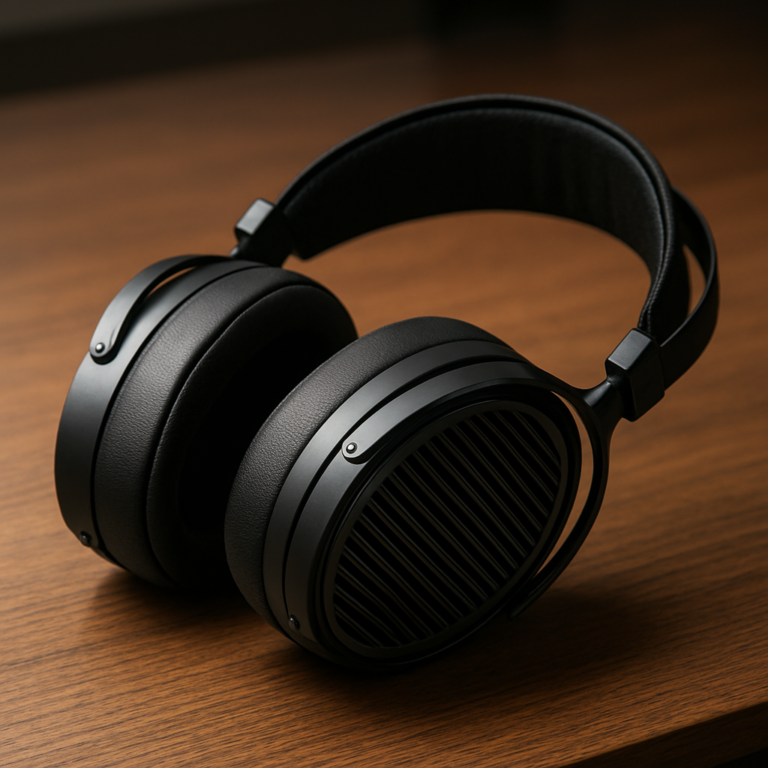
Open-back headphones such as the Grado SR325x can create an airy presentation, but they leak sound in and out. Closed-back headphones like the Beyerdynamic DT 700 PRO X are more practical when other people are nearby. For a wider selection, browse audiophile headphones.
Distortion, noise, and dynamic range
Distortion adds unwanted components to the sound. Noise can come from the recording, electronics, or environment. Dynamic range describes the difference between quieter and louder passages in the program material, not simply a headphone’s advertised maximum volume.
Well-designed headphones generally keep distortion low at normal listening levels. A low distortion number is reassuring, but it does not guarantee a preferred sound. Comfort, response, seal, and matching between left and right drivers matter too.
📊 Headphone Measurements That Help Explain Sound
Measurements help us ask better questions. They do not tell us whether a headphone will make you grin when your favorite bass line drops.
Raw frequency response and target curves
A raw frequency-response graph shows measured output across frequency. But a flat-looking line is not automatically perceived as flat: the head and outer ear alter sound before it reaches the eardrum. Target curves attempt to account for that interaction.
Use graphs to compare broad trends, then listen where possible. A target curve is a reference; personal preference remains valid. RTINGS’ test methodology makes this distinction clear.
Frequency response consistency and channel matching
Fit consistency asks whether a headphone maintains a similar tonal balance when it shifts slightly or is worn by different people. A weak seal can reduce bass, particularly with in-ear models and closed-back designs.
Stereo mismatch is another concern: if the left and right drivers differ in response or level, the stereo image may shift or become less stable. Good channel matching supports accurate placement, although the recording itself also matters.
Bass, mid-range, and treble target compliance
A headphone can have strong bass extension but too much bass quantity for your taste. Midrange balance affects vocals and dialogue. Treble tuning influences crispness, perceived detail, and fatigue.
Rather than asking only, “Does this meet the target?” ask:
- Do vocals sound natural to you?
- Is bass deep without masking the midrange?
- Does treble remain clear without becoming sharp?
- Does the sound stay consistent when you move or adjust the headphones?
Peaks, dips, and pina-related transfer function
Pronounced peaks or dips may cause certain notes to sound emphasized or recessed. The pina-related transfer function (PRTF) examines how headphones interact with the outer ear and can offer clues about spatial cues. It is not a guaranteed score for soundstage, and it does not apply in the same way to in-ear monitors, which bypass the pina.
Harmonic distortion and group delay
Harmonic distortion measures unwanted frequency components added during playback. Group delay looks at how timing varies across frequencies. Both can help identify technical behavior, but their results need context: low distortion is usually not the main reason one competent headphone sounds more enjoyable than another.
Cumulative spectral decay and electrical aspects
Cumulative spectral decay plots show how measured energy changes over time. They can reveal resonances, but analysis settings may affect interpretation; RTINGS cautions that CSD plots can be misleading.
Electrical measurements include impedance and sensitivity. They help estimate how much power a wired headphone may need. Wireless headphones also have built-in electronics and battery limits, so their practical output is assessed differently.
🧩 Fit, Seal, and Noise Control: The Often-Missed Sound Factors
Ear tips, ear pads, glasses, and seal quality
A poor seal is one of the fastest ways to lose bass. With earbuds, try the available tip sizes and check that the nozzle sits securely. With over-ear models, glasses and hair can create gaps under the pads.
A quick fit check:
- Put the headphones on as you normally would.
- Play a familiar track with steady bass.
- Gently adjust the cups or ear tips.
- If bass changes noticeably, improve the seal before judging the tuning.
For replacement tips, pads, and other useful add-ons, browse headphone accessories and earphones.
Active noise cancellation and transparency mode
ANC reduces certain types of external noise, especially steady low-frequency sounds such as cabin rumble. It can make listening easier in noisy places, but its effect and sound character vary by model. Transparency mode brings outside sound back in for awareness.
For travel, a well-sealed ANC headphone can be more useful than an open-back audiophile model, even if the latter wins in a quiet listening room. Explore our Bluetooth headphones for portable options.
Open-back vs. closed-back headphones
| Design | Strengths | Trade-offs |
|---|---|---|
| Open-back | Airy presentation, natural sense of space for many listeners | Leaks sound; little isolation; best in quiet rooms |
| Closed-back | Better isolation and less sound leakage | Can feel less open; fit and cup design strongly affect bass |
| In-ear | Portable, isolating when well fitted | Tip choice and insertion affect comfort and sound |
Open-back headphones are a great home-listening choice if you have a quiet space. Closed-back designs are more considerate in shared rooms and more practical for recording. Neither design automatically sounds better.
🎯 Best Headphone Audio Quality by Usage
Best for critical listening and lossless music
Choose a comfortable wired headphone with a tonal balance you enjoy, then pair it with well-mastered lossless music if you want an uncompressed source. The Sennheiser HD 600 is a familiar wired reference-style option; the Grado SR325x offers a livelier open-back character.
Trade-off: open-back headphones leak sound and provide little isolation. For more models, see audiophile headphones.
Best for commuting and travel
Prioritize a secure fit, effective ANC, reliable Bluetooth, and comfort. The Sony WH-100XM6 and Bose QuietComfort Ultra Headphones are examples of travel-oriented wireless options. Compare their tuning and controls, not only their noise-cancelling claims.
Best for gaming and spatial audio
For gaming, imaging, low latency, comfort, and microphone quality may matter more than hi-res music support. Wired headphones can be a straightforward choice; wireless gaming headsets may offer platform-specific features. Be cautious with virtual surround: it can help positioning for some games, but preferences vary and it may alter music playback.
Best for calls, podcasts, and video
Prioritize clear speech, a useful microphone, comfortable fit, and stable connection. ANC and transparency can help in noisy environments, but check how your voice sounds to other people—microphone performance isn’t the same as headphone playback quality.
For spoken-word listening, a modest midrange lift can improve intelligibility. Keep EQ gentle so voices don’t become thin or nasal.
Best for mixing, mastering, and studio monitoring
Studio headphones should be consistent, comfortable, and informative. Closed-back models such as the Beyerdynamic DT 700 PRO X can limit leakage during recording; open-back models may be more comfortable for focused mixing in a quiet room.
No headphone is a substitute for checking a mix on multiple systems. We’ve caught bass decisions that sounded sensible on studio headphones but wandered off the map on small speakers. Cross-checking is the unglamorous trick that saves the mix.
Best for workouts and outdoor listening
For workouts, prioritize secure fit, sweat resistance, simple controls, and awareness of your surroundings. In-ear models may stay put more reliably than large over-ear headphones, but fit is personal. See earphones and budget headphones for practical options.
Safety note: keep listening levels reasonable outdoors, and use transparency or an open-ear design when you need to hear traffic and people around you.
🛠️ How to Get the Best Sound From Your Headphones
Choose the right audio quality settings
- Set your streaming quality to the highest practical setting for your connection and storage.
- Check Bluetooth codec compatibility on both the source and headphones.
- Turn off processing you don’t want while comparing, including EQ or spatial effects.
- Use a reliable recording you know well; poor mastering can sound poor in any format.
- Don’t chase hi-res labels unless you prefer the convenience of lossless or have a production reason to use higher-resolution files.
Set up EQ without wrecking the mix
EQ can help tune a headphone to your taste. Start with small changes:
- Reduce a piercing treble region slightly rather than boosting every other band.
- Add bass in moderation and check that vocals remain clear.
- Use a trusted headphone-specific profile as a starting point, not a command.
- Keep a saved “flat” preset so you can compare.
- Avoid large boosts that cause clipping or distortion.
EQ is a tool, not a confession that you chose the wrong headphones.
Check fit, firmware, and playback volume
Reseat ear tips, check cup placement, and confirm that pads haven’t worn out. For wireless models, update firmware through the manufacturer’s app and review ANC, EQ, and codec settings.
Then listen at a comfortable level. If you need the volume very high to hear detail, investigate fit, source level, and background noise instead of simply turning it up.
Protect your hearing while listening
Long or loud listening can damage hearing. The World Health Organization’s safe listening guidance recommends managing sound exposure and using safe listening features where available.
- Take regular listening breaks.
- Use effective isolation or ANC so you don’t have to compete with noise.
- Keep volume at a comfortable level.
- Pay attention to ringing or muffled hearing after listening; treat it as a warning to reduce exposure.
🚫 Common Headphone Audio Quality Myths
- ❌ “Hi-res always sounds better.” Higher specifications don’t guarantee a better master or an audible improvement.
- ❌ “A flat graph means perfect sound.” Raw measurements don’t account for every factor in perceived headphone response.
- ❌ “The best Bluetooth codec fixes everything.” Headphone tuning and fit remain central.
- ❌ “More bass means better bass.” Quantity without control can mask vocals and detail.
- ❌ “Expensive always means better.” You may be paying for materials, features, or brand positioning that aren’t your priorities.
- ✅ “The best sound is the one you enjoy.” Measurements help you understand a headphone; your own preferences decide whether it belongs in your ears.
✅ Our Expert Recommendations: What Audio Quality Should You Choose?
Here’s our confident, practical answer:
- For most people: use a comfortable headphone with a sound profile you enjoy and a high-quality stream.
- For convenient daily listening: choose good Bluetooth headphones with a reliable connection and a codec supported by your devices.
- For critical home listening: consider wired, well-tuned headphones, a quiet room, and lossless recordings.
- For travel: prioritize ANC, fit, and comfort over chasing the highest file specification.
- For studio work: look for predictable tuning, fit consistency, and a design suited to recording or mixing.
- For audiophile listening: compare tonal balance, detail, dynamics, imaging, and comfort—not just format labels.
The best headphone audio quality isn’t a single codec or file type. It’s the combination of a good recording, a suitable source, a well-fitting headphone, and a sound signature you genuinely like. We started with a question about the “best” sound; the answer turns out to be the sound that works for your ears and your life.